Welcome to LAIXL, producing EL testers, IV testers, and drone EL
 ×
×
+86 177-0622-2370
xinwen
浏览数:15 发布于:2026-09-21
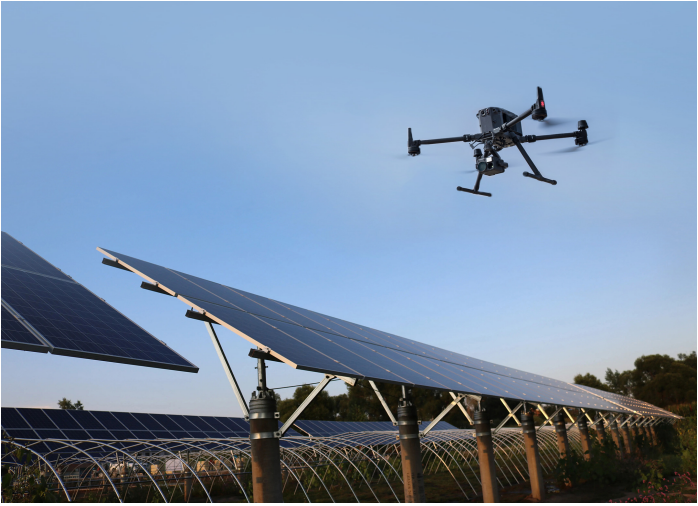 As the scale of domestic photovoltaic power stations continues to expand, traditional manual inspection methods are gradually showing deficiencies in efficiency, safety, and data consistency. Especially for defects such as internal cracks, debris, broken busbars, poor soldering, black cores, and attenuation in components, it is difficult to detect them solely through visual inspection, yet these defects directly affect the power generation efficiency and component lifespan of the power station. UAV EL detection, which combines aerial photography with electroluminescence imaging, can quickly screen for internal defects in components over a large area and has become an important technical means in domestic photovoltaic intelligent operation and maintenance. Shanghai LAILX's UAV EL detection LXH210 caters to the quality inspection needs of EL internal defects in photovoltaic power station array components. With high-frequency imaging, long-distance image transmission, automatic focusing, AI defect recognition, and cloud data management capabilities, it provides an efficient aerial photography integrated solution for power station inspection and operation and maintenance quality control. EL internal defect quality inspection
The prominent feature of LXH210 lies in its deep integration of the drone platform with professional EL imaging capabilities. Photovoltaic power stations typically cover large areas with complex terrains, making it difficult for manual inspection to quickly cover all arrays. Especially in scenarios such as mountains, water surfaces, deserts, and large rooftops, traditional operation methods are inefficient and pose high safety risks. LXH210 relies on the drone's flight capabilities to quickly access different areas of the power station for inspection, reducing the need for personnel to climb, wade, ascend heights, and undertake long-distance hiking tasks. The device supports both photo recording mode and video scanning detection mode, allowing flexible selection based on the type of power station, detection objectives, and on-site conditions. For projects requiring rapid screening of large-area components, this aerial inspection method can significantly enhance operational efficiency.
In terms of imaging capabilities, the LXH210 utilizes a high-frequency InGaAs infrared chip, equipped with high-frequency imaging technology, which enables the acquisition of clear images and videos of internal defects in photovoltaic modules during drone flight. Internal defects in modules are often subtle and complexly distributed, and the clarity of the imaging directly affects the accuracy of defect identification. The LXH210 is equipped with a full-time dark-light autofocus system, which enables real-time automatic zooming during inspection, reducing the reliance on fixed-point flight and manual focus tracking in traditional EL detection, and improving the stability of aerial imaging. In complex power plant environments, this capability helps reduce operational difficulty and ensures more consistent and reliable detection results.
LXH210 also boasts long-distance image transmission and strong environmental adaptability. The device supports image transmission distances up to 15 kilometers, maintaining control and data transmission stability in complex environments. It is equipped with AES-256 image transmission encryption technology to ensure the security of detection data. The six-direction positioning and obstacle avoidance capability enhances safety during flight, making it suitable for operations in environments with dense power station equipment and numerous obstacles. With a maximum flight time of 55 minutes, an IP45 protection level, and an operating temperature range of -20°C to 50°C, it can adapt to various outdoor working conditions. For large-scale ground power stations, mountain power stations, fishery-photovoltaic complementary power stations, and distributed cluster projects in China, these performances contribute to enhancing the practicality and continuity of drone EL detection.
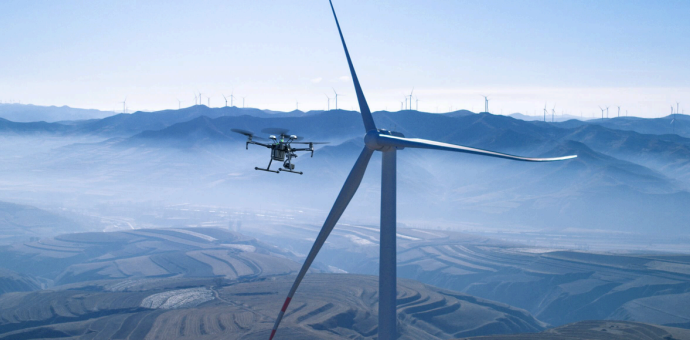
More importantly, LXH210 does not merely address the issue of "being able to capture", but achieves "comprehension, management, and traceability" through software and cloud capabilities. The device can be integrated with the proprietary photovoltaic detection software developed by LAILX, enabling functions such as data storage, operation and maintenance data management, report generation and export, automatic defect identification, and power generation evaluation. Leveraging AI recognition capabilities, the system can automatically identify defects such as fragments, debris, hidden cracks, short circuits, and attenuation, and generate a detection report based on power station modeling and component positioning. For power station owners and operation and maintenance teams, this means that the detection results can be translated into specific fault locations, defect types, and operation and maintenance suggestions, enabling faster entry into the repair, replacement, or revenue evaluation process.
In the domestic photovoltaic (PV) industry, drone-based EL inspection is evolving from a "high-end specialized service" to a "large-scale intelligent operation and maintenance (O&M) tool". The value of the LXH210 lies in its integration of aerial photography, EL imaging, intelligent focusing, long-distance image transmission, AI recognition, and cloud management, making defect screening for large-scale power plants more efficient, safe, and manageable. As the requirements for asset management of PV power plants continue to increase, O&M work will place greater emphasis on data closed-loop, fault localization, and power generation efficiency assurance. The LXH210, leveraging drone-based EL inspection, provides crucial support for the upgrade of PV power plants from manual inspection to intelligent inspection, and also offers a new technological path for the digitalization, professionalization, and large-scale development of domestic PV O&M.
+86 177-0622-2370
Address: 4409 Wuzhong Avenue, Suzhou City, Jiangsu Province
Phone: +86 17706222370
Email: el@lailx.com

LINE