Welcome to LAIXL, producing EL testers, IV testers, and drone EL
 ×
×
+86 177-0622-2370
xinwen
浏览数:13 发布于:2026-09-21
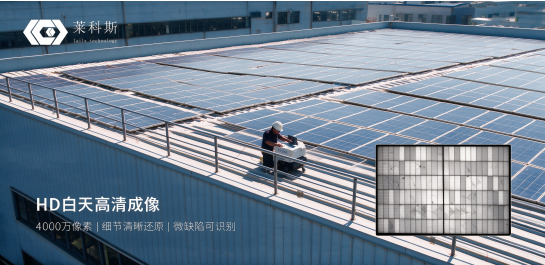 Defects such as internal cracks, broken busbars, soldering defects, and debris in modules are often difficult to detect with the naked eye, yet they can directly affect the power generation efficiency and long-term reliability of photovoltaic power plants. Traditional EL testing has long been limited by the requirement for nighttime or shaded environments, requiring operation and maintenance personnel to shut down the system at night, set up shading shelters, or wait for low-light conditions. This not only results in low operational efficiency but also poses safety risks in complex scenarios such as working at heights, in mountainous areas, and on water surfaces at night. The Shanghai LAILX daytime EL tester LXZ230 addresses this industry challenge by providing daytime string-level EL testing capabilities, offering a more efficient, safer, and scalable detection path for identifying internal defects in photovoltaic power plant modules. Solar cell testing equipment
The significant breakthrough of LXZ230 lies in its ability to break away from the strong dependence on nighttime environment. Traditional EL detection requires avoiding strong light interference, leading to long detection cycles and high organizational costs for large-scale power stations, especially in scenarios such as mountainous power stations, fishery-photovoltaic integration, and rooftop distributed systems, where nighttime operations are more challenging. LXZ230 can conduct detection in strong light environments during the day, adapts to mainstream 1500V photovoltaic string systems, and eliminates the need for component disassembly and wiring, shading sheds, and waiting for nighttime shutdowns, significantly lowering the threshold for on-site operations. For the domestic photovoltaic operation and maintenance market, this means that EL detection is no longer a specialized task that can only be efficiently carried out by a few large projects or professional teams. Instead, it can be more quickly integrated into daily inspection, acceptance sampling, and batch troubleshooting processes.
In terms of detection accuracy, the LXZ230 is equipped with a 40-megapixel high-sensitivity infrared imaging sensor, capable of capturing EL light emission signals from components under strong daylight conditions and identifying defects such as micro-cracks and broken grids down to the 0.1mm level. Internal defects in photovoltaic components often exhibit strong concealment, scattered distribution, and significant development potential. If not detected in a timely manner, they may evolve into hot spots, power attenuation, or even component failure during long-term operation. The LXZ230, through high-pixel imaging and self-developed optical lenses, enhances the ability to restore defect details, enabling operation and maintenance personnel to more clearly assess the internal state of components and providing a basis for subsequent repairs, replacements, and asset assessments.
More importantly, LXZ230 introduces AI automatic image analysis capability into the daytime EL detection process. After traditional EL detection, manual image analysis is often required for each individual image. For large-scale power stations, the volume of imaging data is enormous, making manual image analysis inefficient and susceptible to subjective experience. LXZ230 is equipped with a self-developed third-generation photovoltaic EL defect AI algorithm, which can automatically perform exposure correction, intelligent noise reduction, and defect feature enhancement. It also supports automatic identification and marking of various defects such as hidden cracks, fragments, broken grids, poor soldering, and black cores. After detection, a standardized report with component positioning can be automatically generated, significantly improving the efficiency of the entire imaging and analysis process for a single string. For domestic third-party testing institutions, operation and maintenance service providers, and power station owners, this closed-loop capability from imaging to image analysis to report generation can significantly reduce personnel training costs and improve project delivery efficiency.
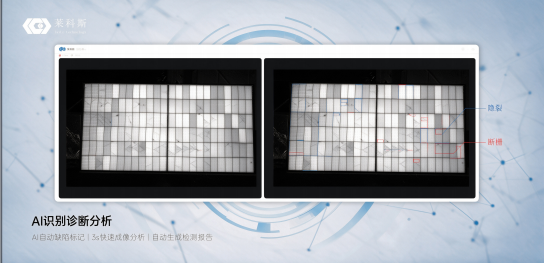
The launch of LXZ230 also meets the dual demands of the domestic photovoltaic industry for "cost reduction and efficiency improvement" and "intelligent operation and maintenance". On the one hand, daytime detection reduces costs such as nighttime operations, shading construction, and personnel scheduling; on the other hand, AI image analysis and automatic reporting lower the threshold for data processing, enabling more small and medium-sized operation and maintenance teams to use professional-grade EL detection equipment. As photovoltaic power plants enter the deepening stage of operation and maintenance from the peak of construction, the demand for module quality verification, stock power plant health checks, and technical renovation project evaluations will continue to grow. LXZ230, starting with daytime string-level detection, transforms EL detection from a "high-threshold specialized operation" into a "scalable and routinely applicable operation and maintenance tool", providing a new option for the domestic photovoltaic industry to enhance the efficiency of module defect detection.
Solar cell testing equipment, outdoor photovoltaic power station tester, photovoltaic EL tester
+86 177-0622-2370
Address: 4409 Wuzhong Avenue, Suzhou City, Jiangsu Province
Phone: +86 17706222370
Email: el@lailx.com

LINE