Welcome to LAIXL, producing EL testers, IV testers, and drone EL
 ×
×
+86 177-0622-2370
xinwen
浏览数:354 发布于:2026-08-20
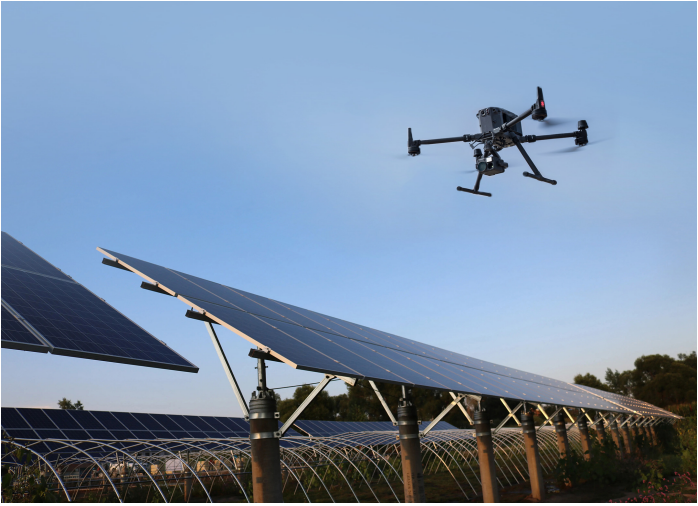 The number of large-scale ground power stations, mountain photovoltaic, and fishery photovoltaic complementary power stations in China continues to grow. Traditional ground portable EL detectors require staff to set up equipment piece by piece for shooting. Faced with stations with millions of components, the inspection cycle is long, and it is difficult for personnel from mountain and water power stations to reach the work site. There are also operational safety risks. The traditional detection mode is no longer able to meet the practical needs of rapid quality inspection and operation and maintenance investigation of large-scale power stations. The EL detection technology of unmanned aerial vehicles has become an important technical direction for solving the internal defect detection of large power plant components due to its ability to conduct large-scale and rapid inspections. Suzhou LAILX has launched the LXH210 unmanned aerial vehicle EL detection system, which relies on an industrial grade RTK unmanned aerial vehicle flight platform, combined with self-developed EL imaging modules and AI intelligent defect recognition systems, to achieve efficient inspection of defects such as hidden cracks, virtual welding, broken grids, and hot spots in large-area photovoltaic power plant components, breaking through the efficiency bottleneck of traditional EL detection and providing a new technical path for the acceptance and operation inspection of large power plants. Solar module EL defect tester
The LXH210 UAV EL detection system uses high-performance RTK UAVs as flight carriers, which can last up to 55 minutes in a single flight, support 15 km long distance image transmission, carry Beidou RTK high-precision positioning, support custom full-automatic cruise routes, and can adapt to complex scenes such as mountains, mudflat, water fishing and light complementation, roof photovoltaic, etc., instead of personnel entering high-risk and difficult to reach areas to carry out detection operations, avoid potential safety hazards for personnel on-site operations, and significantly reduce human investment. The system is equipped with a patented fully automatic focusing EL imaging module, which can achieve real-time autofocus in both photography and video scanning modes. During flight and movement, it can capture images as needed without hovering or waiting for focusing, effectively improving the speed of inspection operations. Under actual testing conditions, a 1MW scale photovoltaic power plant can complete a full set of EL detection in video scanning mode in about 3 hours. Compared with traditional ground equipment, the inspection efficiency can be improved several times. Faced with large-scale gigawatt scale stations, it can greatly compress the overall inspection period. The device can identify more than ten types of internal defects such as hidden cracks, broken grids, fragments, virtual welding, black edges, PID attenuation, hot spots, etc. The imaging image can be transmitted back to the ground control terminal in real time, and the shooting effect can be previewed on site. Flight and shooting parameters can be adjusted in a timely manner to ensure the quality of the collected images.
The LXH210 drone EL detection system binds precise latitude and longitude positioning information to each captured image. Defect images can directly correspond to the specific component positions of the power station array. After receiving the report, operation and maintenance personnel can directly locate the defective components without repeatedly checking and finding the fault location on site. The system is equipped with LAILX's self-developed AI recognition diagnosis and cloud report management platform. After the massive EL image acquisition is completed, AI automatic defect recognition can be completed in batches, automatically counting defect types and quantities, completing power plant modeling, and automatically outputting complete detection reports, including defect distribution maps, defect statistics tables, and power generation loss assessment references. It fully supports third-party quality inspection archiving, operation and maintenance defect elimination management work. The system hardware architecture has the ability to expand, and can switch between mounting EL scanning cameras and infrared thermal imaging cameras as needed. A set of unmanned aerial vehicle platforms takes into account EL hidden crack detection and thermal imaging hot spot inspection, improving equipment utilization and reducing customer comprehensive procurement costs.

In actual project implementation, the equipment is widely used to serve large energy groups, third-party testing agencies, and EPC general contracting enterprises. It is used for completion acceptance sampling of new large-scale power plants, annual hidden danger investigation of existing large-scale power plants, and batch quality evaluation of old photovoltaic modules. The advantages of the LXH210 unmanned aerial vehicle EL detection system are fully demonstrated in scenarios where traditional detection methods are difficult to carry out, such as terrain undulations in mountainous power stations and complementary fishing light water operations. LAILX not only provides a complete hardware system, but also offers flight operation training, image interpretation guidance, and AI algorithm continuous iteration and upgrading services to help customers quickly master the entire unmanned aerial vehicle EL detection process. The photovoltaic industry is continuously developing towards large-scale and high installed capacity, and the traditional manual inspection mode is no longer suitable for the pace of industry development. The LXH210 unmanned aerial vehicle EL detection system deeply integrates the unmanned aerial vehicle platform with EL electroluminescent detection technology, balancing detection efficiency, detection accuracy, and operational safety, promoting the upgrading of photovoltaic module defect detection towards automation and scale, helping large-scale photovoltaic power plants achieve refined operation and maintenance, and safeguarding the investment returns of photovoltaic projects.
Solar module EL defect tester, photovoltaic power plant EL detection equipment, EL internal defect quality inspection
+86 177-0622-2370
Address: 4409 Wuzhong Avenue, Suzhou City, Jiangsu Province
Phone: +86 17706222370
Email: el@lailx.com

LINE