Welcome to LAIXL, producing EL testers, IV testers, and drone EL
 ×
×
+86 177-0622-2370
xinwen
浏览数:1,270 发布于:2026-03-26
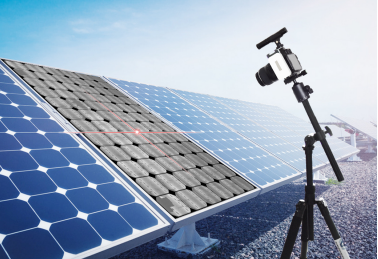
The application scenarios of photovoltaic modules are becoming increasingly diversified, from large-scale ground power stations to rooftop distributed power stations, from industrial and commercial photovoltaic projects to photovoltaic building integration (BIPV), from module factory sampling to second-hand module screening. The demand for testing equipment varies significantly in different scenarios. Traditional EL detection equipment often has the problem of insufficient scene adaptability, making it difficult to meet the requirements of full scene detection. Recently, the LAILX LXG30 portable EL detector in Suzhou has achieved a breakthrough in non-destructive testing of photovoltaic modules in all scenarios through innovative design and comprehensive performance. It is suitable for the testing needs of module production, power station construction, operation and maintenance, and second-hand evaluation, and has become the core equipment for quality control of the entire photovoltaic industry chain.
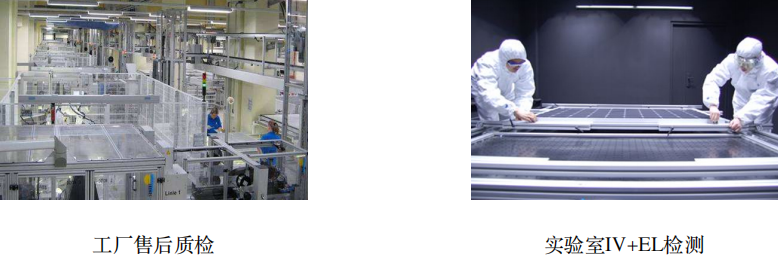
The component production process is the first checkpoint of quality control, with extremely high requirements for the accuracy, efficiency, and batch testing capability of testing equipment. Traditional component factory testing equipment is mostly fixed desktop equipment, which is bulky and difficult to deploy, making it difficult to adapt to the flexible testing needs of production lines. In addition, some equipment has insufficient ability to identify small defects, which can easily lead to unqualified components entering the market. The LXG30 portable EL detector is optimized for component production scenarios, with 24 million pixel high-definition imaging and 0.5mm level defect recognition accuracy. It can accurately detect defects such as hidden cracks, broken grids, sintering, and process pollution during the component production process, ensuring the quality of the factory components. 5-second fast imaging and synchronized detection of 12 components, adapted to the batch inspection needs of production lines, can complete the detection of over 800 components in a single day, greatly improving production inspection efficiency and shortening product delivery cycles. At the same time, the device supports barcode entry and automatic classification statistics functions, which can quickly associate component batches, production processes, and other data, achieve production quality traceability, help enterprises optimize production processes, and improve product qualification rates.
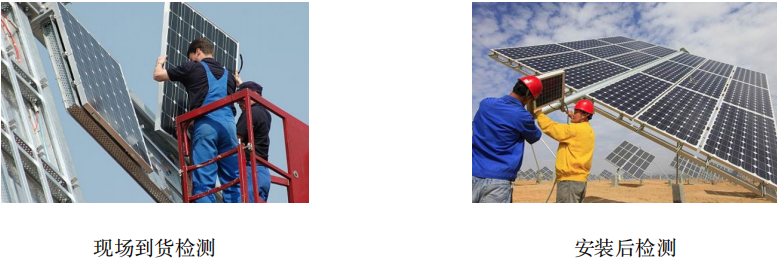
During the construction phase of the power station, component testing is the key to ensuring project quality and later power generation efficiency. Different construction scenarios such as ground power stations, rooftop power stations, and BIPV projects have complex site conditions, difficulty in transporting and installing components, and limited testing deployment. The lightweight design and full scene adaptability of LXG30 perfectly solve the problem of construction scene detection. The whole machine is equipped with a three proof suitcase, which can be easily picked up and transported by a single person, making it easy to enter complex venues such as mountains, rooftops, and urban buildings. No need for professional darkroom deployment, accurate detection can also be carried out in low irradiance environments, suitable for rapid acceptance testing of components after installation during power plant construction, avoiding rework costs caused by failure to detect component defects in a timely manner. The device is equipped with a built-in laser positioning function, which can accurately lock the detection area. Combined with a lightweight carbon fiber bracket, it can achieve blind spot detection of components at different installation angles, ensuring the accuracy of component quality acceptance during the construction phase.
 The operation and maintenance process is the core of the full lifecycle management of photovoltaic power plants, and the testing requirements are concentrated in daily inspections, fault diagnosis, regular maintenance, and other aspects. LXG30, with its efficient and convenient features, has become the core tool for operation and maintenance. 30 second rapid detection efficiency, suitable for daily inspection of batch component troubleshooting needs, timely detection of defects such as hidden cracks, virtual soldering, and thermal spot attenuation, to avoid the expansion of defects and the decrease in power generation efficiency. Designed for battery life without reliance on mains electricity, suitable for operation and maintenance in remote mountainous areas, outdoor power stations, and other scenarios without power supply; Wireless control and portable stand design, suitable for high-altitude, narrow and other dangerous scenarios, ensuring the safety of operation and maintenance personnel. At the same time, the device supports historical data comparison and analysis functions, which can track the trend of component defect changes, provide data support for the formulation of regular maintenance plans, achieve preventive maintenance, and reduce operation and maintenance costs.
The screening and recycling scenarios for second-hand components require extremely high precision and comprehensiveness of the testing equipment. Due to different service life and usage environments, second-hand components have complex defect types, and some components have hidden decay and hidden defects, which are difficult to identify through visual inspection. The LXG30 has high-definition imaging and full defect detection capabilities, which can accurately identify more than 20 types of defects such as hidden cracks, broken grids, black core chips, attenuation, PID mismatch, etc. in second-hand components. At the same time, it can detect the degradation of component power generation performance, providing accurate basis for component recycling and graded pricing. Equipment detection data can generate standardized reports, clearly presenting information such as component defect types, quantities, and attenuation degrees, helping recycling enterprises achieve fine grading of components, improve resource utilization, and promote the development of circular economy for photovoltaic modules.
 In addition to core application scenarios, LXG30 is also suitable for third-party testing, scientific research experiments, teaching and training, and other scenarios. At third-party testing institutions, equipment can provide authoritative and accurate component testing services to meet customers' diverse testing needs; In the field of scientific research, equipment can be used for defect detection research of new component materials and processes, providing data support for technological innovation; In teaching and training, equipment can serve as practical teaching aids for identifying defects in photovoltaic modules, assisting in the cultivation of professional talents.
To ensure the effectiveness of full scene detection, Suzhou LAILX has carried out multiple special optimizations for LXG30. For special components such as BIPV modules, the equipment has optimized imaging parameters and detection algorithms to accurately adapt to the detection of special structures such as glass curtain wall components and transparent components; For new components such as high-efficiency PERC and TOPCon, the equipment is upgraded with a low current high-precision detection module that can adapt to low-power and high-efficiency component detection, meeting the needs of new component detection; In response to harsh environments such as humidity, dust, and high temperatures, the equipment adopts a three proof design to enhance the overall protection performance and ensure stable operation in complex environments.
In terms of quality and service, LXG30 has been tested by authoritative institutions such as the National Photovoltaic Product Quality Supervision and Inspection Center, and all performance indicators have reached industry-leading levels. Suzhou LAILX provides customized services for the entire scene, providing personalized equipment configuration, operation training, technical support and other services according to different users' detection scenarios and needs, ensuring that the equipment can achieve the best detection effect. At the same time, the brand has established a comprehensive after-sales system, providing 24-hour technical response, regular equipment maintenance, free software upgrades, and other services to ensure users have a full lifecycle experience.
The General Manager of Suzhou LAILX New Energy Technology Co., Ltd. stated that full scene adaptation is one of the core design concepts of LXG30. The current photovoltaic industry is developing rapidly and its application scenarios are constantly expanding. Single scene detection equipment is no longer able to meet the needs of the entire industry chain. The launch of LXG30 aims to create a testing equipment that is suitable for the entire process and scene of the photovoltaic industry, providing a one-stop testing solution for component production, power station construction, operation and maintenance, second-hand evaluation, etc., and promoting the standardization and efficiency of quality control throughout the photovoltaic industry chain.
At present, LXG30 has been widely applied in various provinces and cities across the country, serving hundreds of power station operators, component manufacturers, and third-party testing institutions, and has gained widespread market recognition. We sincerely invite partners from all walks of life to work together to expand the market for full scenario detection applications, empower the high-quality development of the photovoltaic industry with technological innovation, and help the global clean energy transformation.
+86 177-0622-2370
Address: 4409 Wuzhong Avenue, Suzhou City, Jiangsu Province
Phone: +86 17706222370
Email: el@lailx.com

LINE