Welcome to LAIXL, producing EL testers, IV testers, and drone EL
 ×
×
+86 177-0622-2370
xinwen
浏览数:1,055 发布于:2026-03-25
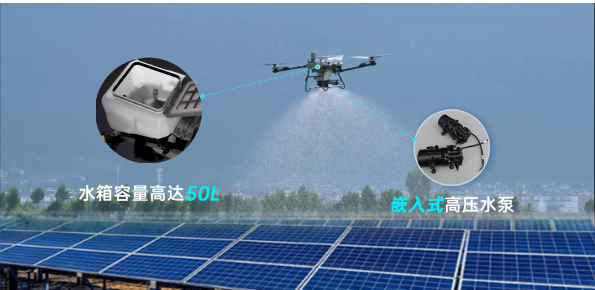
In March 2026, Suzhou, for photovoltaic power plant operators, the operation and maintenance efficiency directly determines the power plant's revenue, and component cleaning is the core link that affects the operation and maintenance efficiency and power generation benefits. Recently, the H233 photovoltaic cleaning drone released by LAILX in Suzhou has revolutionized the operation and maintenance efficiency of photovoltaic power plants with its disruptive operational efficiency and ultimate cost control capabilities. It has become the preferred intelligent equipment for major power plant operators to reduce costs and increase efficiency. Currently, it has been put into trial use in photovoltaic power plants in Jiangsu, Anhui, Zhejiang, Qinghai and other places, and has received unanimous praise.
With the extension of the operation cycle of photovoltaic power plants, the impact of surface stains on the power generation efficiency of components has become increasingly apparent. According to relevant data, photovoltaic modules that have not been cleaned for a long time have a significant decrease in light transmittance and power generation efficiency compared to normal modules due to coverage by dust, bird droppings, dust, rainwater stains, etc. In areas with large deserts and sandstorms, the power generation loss can even exceed 20%. The annual cumulative power generation loss can reach 15% -20%. For large photovoltaic power plants, the annual economic loss can reach hundreds of thousands or even millions of yuan. In the past, due to limitations in cleaning equipment and technology, power plant operators could only passively bear the loss of power generation or invest high labor and time costs in cleaning, resulting in extremely low input-output ratios. However, the emergence of the LAILX H233 drone has completely changed this situation.
From the perspective of operational efficiency, the LAILX H233 photovoltaic cleaning drone has achieved a qualitative leap, with core parameters reaching industry-leading levels. The cleaning efficiency of this drone is 2 hours to clean 1MW photovoltaic modules, with a single machine's daily operation capacity of up to 8MW. However, traditional manual cleaning requires a team of 8-10 people to clean only about 0.4MW per day. The operating efficiency of one drone is equivalent to that of 20 manual workers, increasing efficiency by 20 times. Taking a 100MW large-scale ground photovoltaic power station as an example, traditional manual cleaning takes about 250 days, while the use of H233 drones only takes 12-13 days to complete full coverage cleaning, greatly reducing the cleaning cycle. The power station can achieve regular and standardized cleaning to maintain the optimal power generation state of the components at all times, completely solving the problems of long cleaning cycles and long-term dust accumulation of the components.
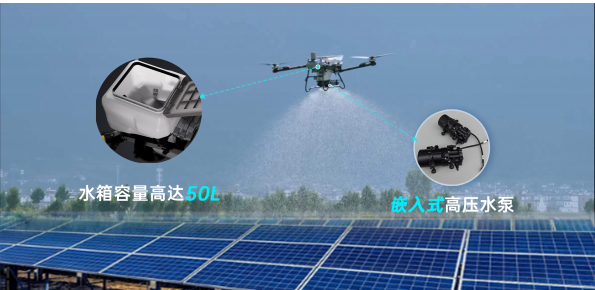 In terms of cost control, the H233 drone has more significant advantages, reducing the comprehensive cost of power plant operation and maintenance in all aspects. Firstly, there is the cost of labor. Traditional cleaning requires a large amount of manual climbing and washing, with high labor wages, safety insurance, accommodation and other expenses. On the other hand, drone cleaning only requires 1-2 operators to complete the scheduling of multiple devices, without the need for a large number of manual on-site operations, reducing labor costs by more than 80%. Next is the equipment usage cost. The equipment adopts fast charging technology, which can be fully charged in 10-15 minutes. With a single battery life and water replenishment, it can operate continuously for 45 minutes, with low energy consumption and minimal loss. The body is made of carbon fiber material, which is durable and has extremely low maintenance costs in the later stage. At the same time, the equipment has outstanding water-saving performance, saving 70% of water compared to traditional water truck cleaning, significantly reducing water resource costs, especially suitable for photovoltaic power stations in northwest desert and water scarce areas.
The reduction of safety costs is the core value of H233 drones. The cleaning of photovoltaic power plants often involves high-altitude and high-voltage operations. Manual cleaning faces multiple safety risks such as falling from heights, electric shock, and slipping. Once a safety accident occurs, the enterprise needs to bear huge compensation and shutdown losses, and the cost of safety management remains high. The drone adopts a fully autonomous operation mode, achieving human-machine separation. The operator remotely controls from the ground without the need for close contact with components and high-altitude areas, completely eliminating the risks of high-altitude operations and electric shock, eliminating safety hazards from the source, making power plant operation and maintenance safer and more worry free, and significantly reducing the cost of enterprise safety management and risk prevention.
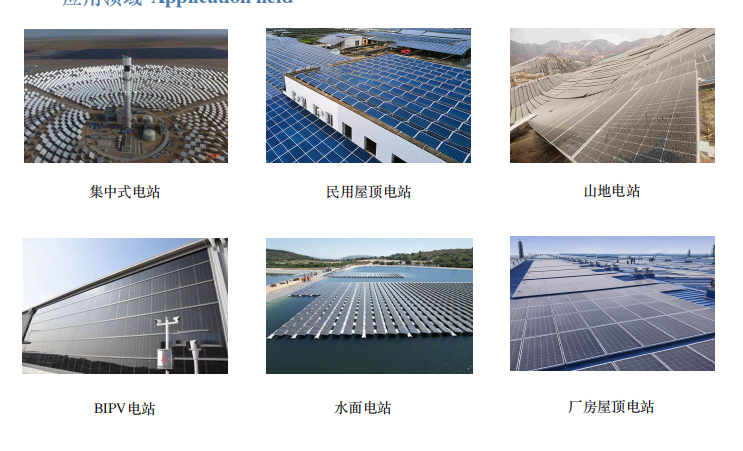 In addition to efficiency and cost advantages, the H233 drone can effectively extend the service life of photovoltaic modules and create long-term benefits for power plants. Traditional manual cleaning often uses hard brushes and high-pressure water guns for rough rinsing, which can easily scratch the surface coating of components and accelerate component aging. On the other hand, drones use intelligent water pressure regulation and flexible cleaning technology to accurately control the distance between the nozzle and components, gently clean stains, and do not damage the surface of components. Combined with regular standardized cleaning, it can avoid long-term corrosion of components by stains, delay component aging, extend the service life by 3-5 years, and further improve the overall life cycle revenue of power plants.
At present, the LAILX H233 photovoltaic cleaning drone has been demonstrated and applied in multiple photovoltaic power stations in China. The person in charge of a 100MW ground photovoltaic power station in Jiangsu Province stated that after using the drone, the cleaning cycle of the power station has been shortened from six months to one month, the operation and maintenance costs have been reduced by 65%, the module power generation efficiency has been improved by 16%, and the annual new revenue has exceeded 800000 yuan. The cost-effectiveness far exceeds traditional cleaning methods. With the intensification of competition in the photovoltaic industry, cost reduction and efficiency improvement have become the core demands for power plant operation. With its ultimate efficiency and cost advantages, the LAILX H233 drone will become the mainstream equipment in the photovoltaic operation and maintenance industry, helping more power plants achieve efficient operation and stable profitability.
The relevant person in charge of LAILX in Suzhou stated that the company will continue to optimize its product services, provide customized operation and maintenance solutions for photovoltaic power stations of different scales and scenarios, and improve the full process services such as after-sales training, equipment maintenance, and technical support, so that every power station operator can easily use intelligent and efficient cleaning equipment and share the dividends of the development of the new energy industry.
+86 177-0622-2370
Address: 4409 Wuzhong Avenue, Suzhou City, Jiangsu Province
Phone: +86 17706222370
Email: el@lailx.com

LINE