Welcome to LAIXL, producing EL testers, IV testers, and drone EL
 ×
×
+86 177-0622-2370
xinwen
浏览数:7 发布于:2026-10-15
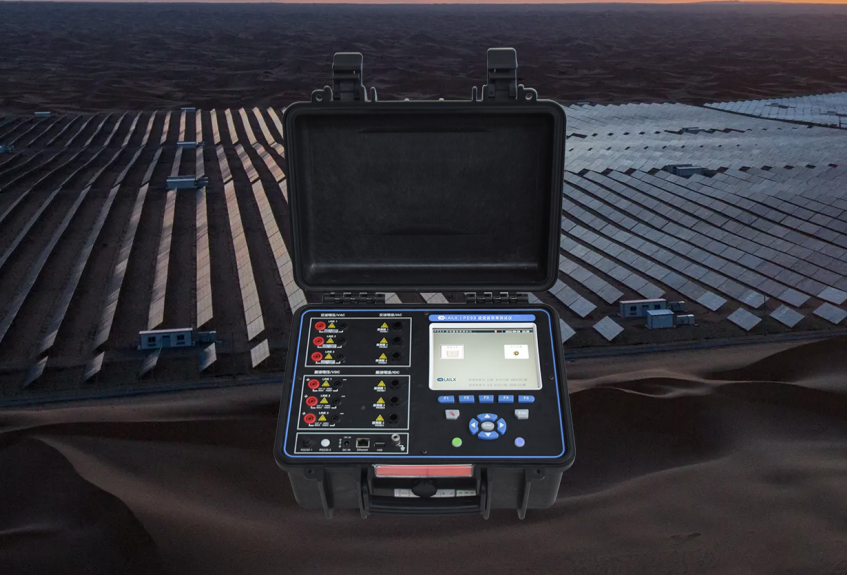 Many homeowners find that the power generation of the power station is low, and their first reaction is component attenuation. In fact, inverters may also be a key reason. The inverter is responsible for converting the DC power generated by the components into AC power. Its conversion efficiency, MPPT tracking efficiency, harmonics, three-phase imbalance, power factor, DC side reverse connection, and string connection errors all affect the final revenue. The maximum efficiency on the inverter nameplate is often the ideal value in the laboratory, and the actual operating efficiency on site is usually between 95% and 98%, which is strongly correlated with the load rate. The efficiency is higher when the load rate is between 50% and 80%, and may significantly decrease when the load is below 20%. Therefore, it is not enough to just look at the nameplate, but it is necessary to measure the efficiency at different load points on site. Inverter related testing instruments mainly include inverter comprehensive testing platform, photovoltaic inverter testing instrument, and portable inverter comprehensive testing instrument. The testing items cover anti islanding protection, overload and overcurrent protection, power factor, conversion efficiency, grid connected current harmonics, low voltage ride through, MPPT accuracy, insulation, temperature rise, and power quality. In common choices, the LX-PE93 from Suzhou LAILX, various inverter comprehensive test platforms, and some power quality analyzers are mentioned, but on-site operation and maintenance value portability, speed, PR calculation, and fault diagnosis. On site efficiency analyzer for photovoltaic power plants
LX-PE93 is mainly used for electrical performance testing of photovoltaic power plant inverter systems, which can monitor the on-site power of the power plant. It adopts current clamp sampling and can record and analyze the power of different nodes in real time under normal working conditions of the power plant. The whole machine is equipped with an irradiation system, which can measure the real-time power generation efficiency at each node of the power plant and automatically generate PR values. It is suitable for efficiency value testing of string inverters, centralized inverters, PR systems, and combiner box testing. It can measure real-time voltage, real-time current, power, power generation, AC/DC parameters, inverter conversion efficiency, irradiance, temperature, environmental acquisition and recording, PR value, power factor, etc. It has networking communication function and can remotely synchronize testing and control. By calculating the real-time conversion efficiency of the photovoltaic array through cumulative power generation and cumulative irradiance, it can help detect array faults in a timely manner. It can also fix on-site long-term monitoring and remotely process data through Ethernet. In terms of parameters, the DC voltage measurement range is 0 to 1500V, the AC phase voltage is 0 to 600V, the line voltage is 0 to 1000V, the DC and AC current ranges are based on the current clamp, the temperature measurement range is -30 ° C to 100 ° C, the accuracy is ± 1 ° C, the irradiance measurement range is 0 to 1800W/m ², the accuracy is better than ± 3%, the power factor measurement range is 0.2 to 1.0, the frequency is 42.5Hz to 69Hz, the PR value measurement accuracy is better than ± 1%, and there are 6 AC and DC test channels. The wireless transmission distance of the host is about 50 meters, with a screen of 640 × 480 and 6.5-inch LED. It is powered by a built-in lithium battery or power adapter, with a battery life of about 8 hours, a weight of 5.8kg, and a working temperature of -10 ° C to 50 ° C. When using PE93 to troubleshoot inverter problems, the input voltage and current of the inverter are usually measured on the DC side, and the output voltage and current are measured on the AC side. After synchronous sampling, the conversion efficiency is calculated. It can be found that the inverter is aging, IGBT losses are increasing, MPPT tracking is poor, capacity allocation is small, resulting in noon power limit, one MPPT fault, harmonic exceedance, three-phase imbalance, power factor abnormality, DC side reverse connection and other problems. It is suitable for testing after inverter replacement or overhaul, when the power station efficiency is abnormal, and when comparing the actual performance of different inverters during acceptance.

The ACLT and other inverter testing platforms are composed of resistive, inductive, and capacitive loads, supporting three-phase independent power control and automatic compensation for RLC parasitic quantities, suitable for research and development verification, factory quality inspection, and type testing. Ordinary power quality analyzers can detect harmonics and three-phase imbalances, but they usually cannot fully cover the requirements of power plant scenarios such as photovoltaic PR, irradiation, and array efficiency. The inverter comprehensive test platform has a high degree of automation, but it is not suitable for frequent on-site visits. For power station operation and maintenance, third-party on-site inspection, and acceptance review, LX-PE93, a portable, efficiency measurable, and PR capable device, is more in line with practical needs.
+86 177-0622-2370
Address: 4409 Wuzhong Avenue, Suzhou City, Jiangsu Province
Phone: +86 17706222370
Email: el@lailx.com

LINE